Industry demands are putting pressure on the poultry processing line. Whether it’s responding to reduced labor availability, a shift to sustainable packaging, or even trying to maximize output amid rising costs, poultry processing plant managers are navigating a host of challenges.
One of the biggest opportunities for efficiency is where the bird meets the bag.
Poultry packaging automation can provide big gains, but not all depositors were created with this industry in mind.
With poultry, you are dealing with wet, raw chicken product of varying shape and size. Inconsistent placement can lead to wet seals — creating more issues downline.
The Fremont Automation Saddlepack Depositor was built to solve the unique issues chicken processors face.
Instead of adding complexity, Fremont Automation focused on removing failure points. The result is a poultry packaging automation system built to deliver dry seals, reliable depositing, simplified maintenance, and fast integration with nearly any thermoforming machine.
Why is poultry depositing automation a challenge?
Automating the packaging of poultry products is challenging because chicken doesn’t behave like a dry, uniform, free-flowing material.
Some automated systems work well for products like shredded cheese, snacks, powders, and other items that flow predictably through weighing and depositing equipment. Poultry is different. Chicken is wet, slippery, irregular, and often handled in whole-muscle pieces. It can stick to equipment, shift unpredictably, or carry liquid into areas where it causes problems.
That’s why comparing a poultry-depositing application to a general food-depositing machine is a non-starter. The right machine depends on the product and the packaging goal.
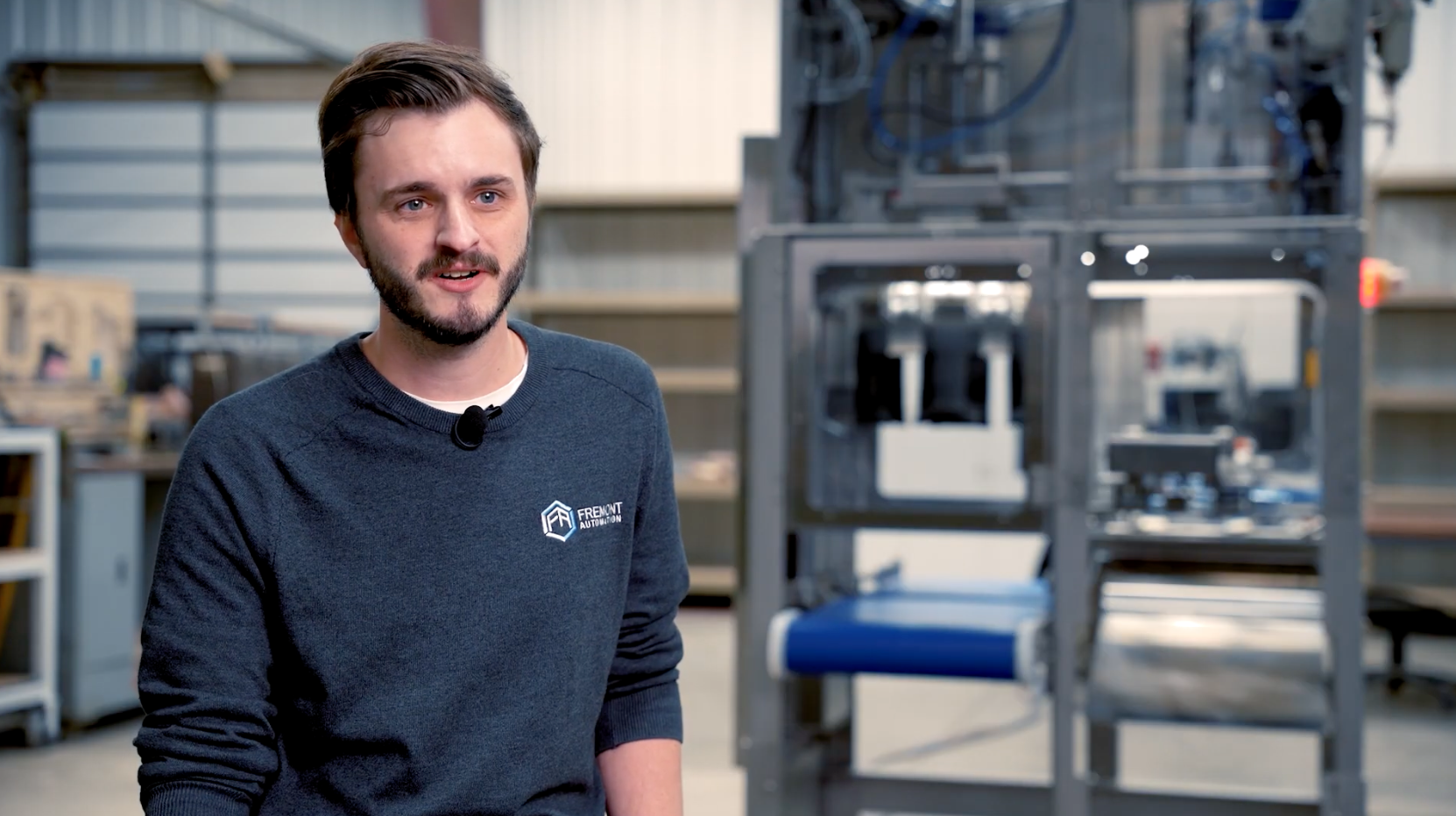
Ben Benes, an engineer and part of the founding family of Fremont Automation, puts it simply: “Why someone would use our depositor versus something else is that it has really low downtime. It’s a simple machine, and a really robustly made machine, specifically for poultry products. You get consistent packages that way.”
We didn’t build the Saddlepack Depositor as a one-size-fits-all automated packaging machine. We built it around a specific poultry packaging problem: how to move raw chicken products into pouches faster and more consistently without creating leakers, sanitation issues, or maintenance headaches.

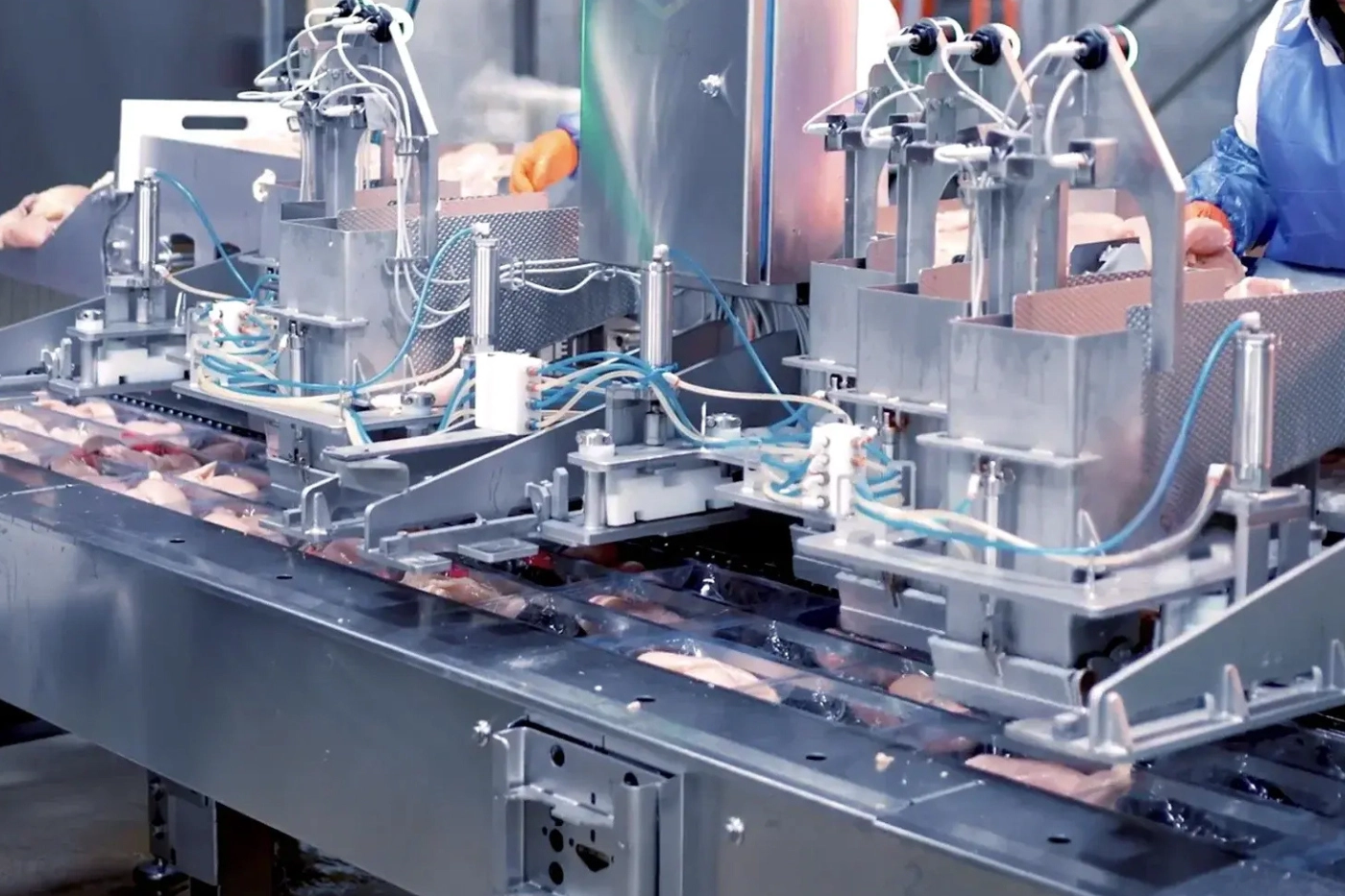
Precision chutes deposit chicken directly into the pouch to protect the seal area.
The precision chute design is one of the most important parts of the Saddlepack Depositor because it addresses the issue that causes so much downstream frustration: liquid and product getting onto the seal area.
“Instead of having the chicken four or five inches up and letting it fall, we come down right to where the package is,” says Benes. “Coming down all the way into the package is what made it special and really helps with the accuracy. We’re getting all of those juices off of the seals and into that package.”
The depositor chute guides the product fully into the pouch and opens exactly where the product needs to be. The chutes also collect liquid as part of the process. When the chute closes, it traps moisture.
“When the thermoformer is moving and packages are traveling underneath it, this isn’t going to drip liquid onto those seals,” says Benes.
Cleaner placement means fewer wet seals. Fewer wet seals lead to fewer leakers. And fewer leakers mean less rework, less wasted product and packaging, and more confidence that the packages leaving your line are the packages you intended to ship. The depositor isn’t just moving faster than a manual process. It’s controlling the part of the process that most directly affects package integrity.
The depositor will work with your existing thermoformer to load up to 160 pouches per minute.
We built the Fremont Automation Saddlepack Depositor to work with any OEM thermoforming machine.
“Package configuration starts with the thermoformer,” explains Benes. “During installation, we have the thermoformer make pouches, then align the depositor directly to those pouches so every chute is in the right position. From there, the depositor and thermoformer communicate so product drops only when the next set of pouches is ready.”
The Saddlepack Depositor loads up to 160 pouches per minute, depending on the product, pouch setup, and thermoformer speed. The depositor can be customized to any package configuration, whether you’re packing traditional saddlepacks, rigid trays, or other formed packaging.
By combining fast loading with precise placement, you’re not just sending more poultry down the line and hoping for the best. You can load faster while keeping the seal area safe. This avoids slowdowns at common bottlenecks, keeps product moving smoothly into the thermoformer, and reduces the need to add staff when packaging demand rises.
Maximize your workforce with only three operators needed for the depositor.
The Fremont Automation Saddlepack Depositor keeps people involved where it counts, requiring just three operators to work the equipment.
“The really critical thing the operator does is give you your last-minute inspection of the chicken. The fact that you have that last chance for inspection is a big deal,” says Benes.
Two operators stand on height-adjustable platforms to feed chicken into the chutes. They have a final chance to check the product before it goes into the pouch. If something isn’t right, they can send it to the downgrade chute. There’s also a tray table for a final operator to serve as “window dresser,” arranging the product so placement is verified before sealing.
Poultry automation shouldn’t treat every piece of chicken the same. It should help operators handle the product they know best. With the Saddlepack Depositor, automation manages timing, movement, and depositing. Operators still control quality, sorting, and product appearance.
“If you’re fully manual, it’s common to have four to six people filling pouches and one person still window dressing,” says Ben, identifying one of the biggest advantages of the Fremont Automation Saddlepack depositor.
Not only do you need fewer people in one spot, but there is reduced repetition, less awkward reaching, and a steadier work pace. This lets you move employees to more valuable roles in the plant, which is real value with the labor struggles seen in food processing.
No need for special sanitation procedures. The depositor is wash-down ready.
The sanitation process can’t slow your operation. The Fremont Automation Saddlepack Depositor has a NEMA 4X, IP69 enclosure and uses approved food-grade plastic. All food-contact areas have sanitary welds to prevent gaps where liquid could collect. Since it’s fully washdown-ready, your sanitation team doesn’t need to bag, cover, or remove special parts before cleaning.
The Clean-In-Place belt system lets you sanitize the belt without disassembling the depositor. It cleans both sides of the belt, plus the sprocket and motor. This makes washdowns easier and more complete. Your team can clean what’s needed, reach important areas, and prepare the line for the next shift without any extra teardown.
Engineered for maintenance simplicity and lower total cost of ownership.
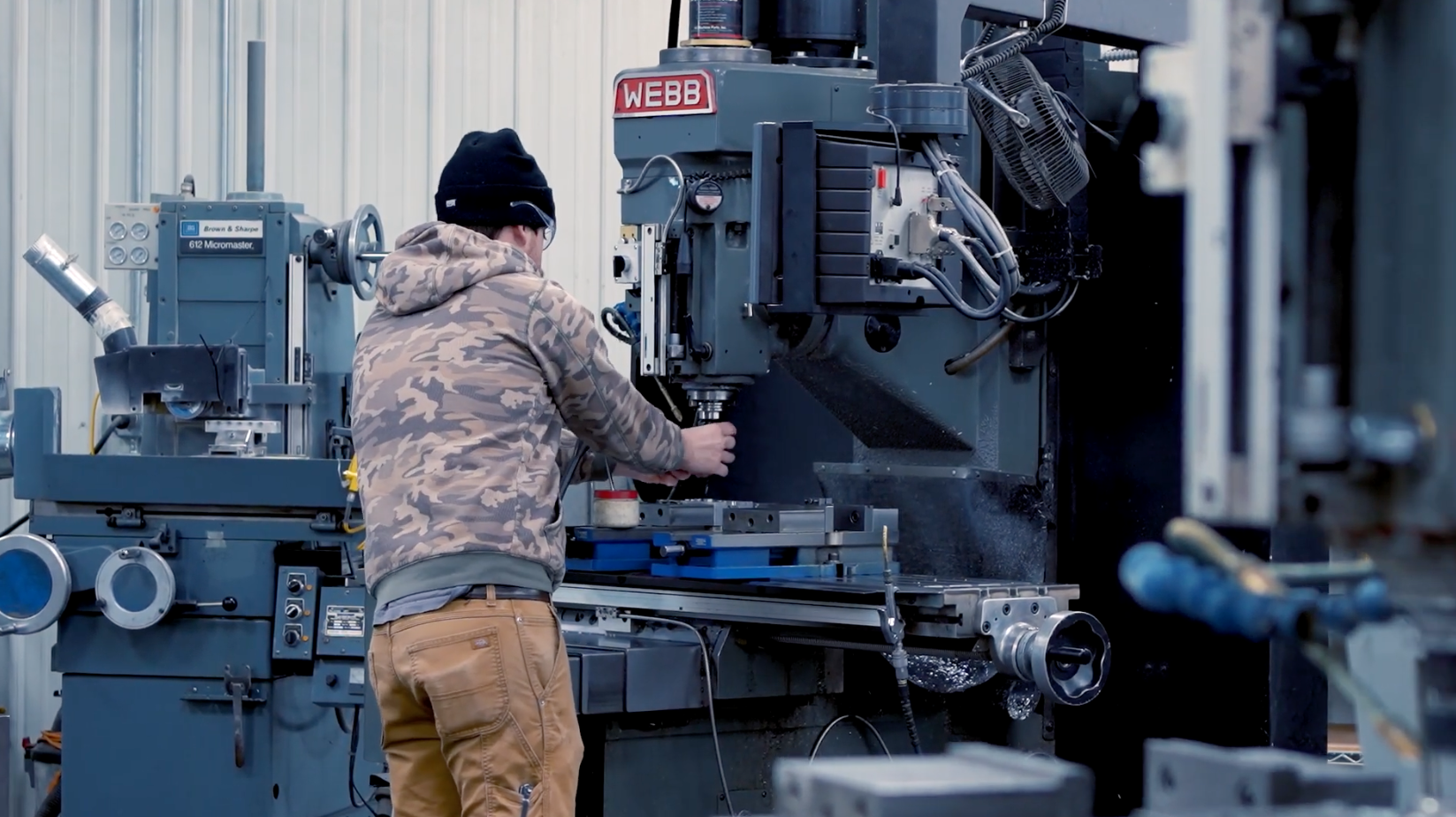
We design our machines for the people who keep them running.
“We start out with a concept, we design it, we build it, and then we start taking stuff away,” says Benes, describing Fremont Automation’s engineering approach. “That’s where you end up with a machine like this: simpler and simpler. It’s actually simpler to make something robust and strong. If we’re worried that something might not be strong enough, we just make it a hell of a lot stronger.”
This rugged yet simple philosophy produces a machine that’s hardworking yet easy to maintain. No fasteners or critical parts are in hard-to-reach places. The depositor uses IO Link and quick-connect M12 sensor connections so you can swap sensors, buttons, and lights quickly without soldering or opening the electrical box. Replacing a part doesn’t require a long teardown, and we have any part you might need in stock.
All in all, the depositor only costs an average of $300 per month to maintain.
Install an automated depositor in a day. Multiple in a weekend.
New equipment shouldn’t put production at risk. We’ve got installation of the depositor down to a science. The installation itself is straightforward. We align the depositor with your thermoformer’s pouches, level it using the adjustable legs, and lock it in place.
“We can install a depositor in one day so long as we get the electrical and air supply to us. We can do multiple on a weekend.”
Key installation requirements include:
- Electrical: 110 VAC 1Ph 4A, 15A breaker
- Air: 2.3 CFM at 50 PSI
- Footprint: 12’ x 6’ x 6’
- Minimum aisle width: 7’
But installation isn’t over once the machine is secured. We believe onboarding, training, and on-site troubleshooting are part of the process. For us, placing a depositor in the plant isn’t the last step, but the first.
“After we install the machine, we will have two people there for a week straight, making sure that everything is running well,” says Benes.
The training is for both operators and technicians. The Fremont Automation team will teach best practices, how to use the various UX touch points, and watch the operators use the equipment shift after shift. They’re looking for any little tweaks that may be needed and watching for bad habits the operators might pick up on the new equipment.
“We’re just there during the ramp-up to make sure there aren’t any issues. If we see one, we’re going to do something about it. We’ll fix it instead of just saying, ‘you figure it out.’ We won’t leave until the customer is at a point where they’re happy.”
How to evaluate ROI and compare automated depositing equipment.
When investing in new depositing equipment, savings usually come from four places: fewer people required at the pouch-loading point, fewer leakers to rework, less product and packaging waste, and fewer maintenance interruptions.
When comparing automated depositing equipment, speed isn’t the only factor. Ask the questions that truly matter for your poultry line:
- Can it handle wet, irregular poultry without sticking, bridging, or misplacing product?
- Does it protect the seal area from liquid and product contamination?
- Can it keep pace with your thermoforming machine?
- Does it integrate with your existing OEM equipment?
- Will it fit your footprint without a major line redesign?
- Can operators still inspect and downgrade product before packaging?
- Is it full washdown ready?
- Can maintenance teams access and replace parts quickly?
- Who installs it, trains your team, and supports it after startup?
This is what sets the Fremont Automation Saddlepack Depositor apart from generic equipment. We designed it specifically for poultry plants, based on our experience in poultry packaging automation. Our systems are custom-engineered for processing environments, deliver proven results with ROI in less than year, and we work closely with processors as partners.
Free Custom Automation Layout & Line Simulation
We’ll map your current setup and show you what it would look like—and perform like—with automation integrated.
- Identify bottlenecks
- Compare labor requirements
- Visualize thermoforming machine integration
- Estimate throughput improvements
Request your custom automation layout and line simulation today
FAQ
The Saddlepack Depositor lowers directly into the pouch before depositing product, helping reduce seal contamination, improve package consistency, and minimize leaking packages.
Fremont Automation helps poultry processors address labor shortages by automating repetitive, labor-intensive packaging tasks so plants can keep lines moving with fewer manual touchpoints. The Saddlepack Depositor can run with just three operators. For comparison, a fully manual process typically requires four to six people just to fill the pouches, plus an additional window dresser.
Yes. The machine is designed to integrate with virtually any thermoforming machine using cable-based or wireless communication.
By depositing product directly inside the pouch instead of dropping it from above, the system helps keep juices away from the seal area.
Yes. The machine is fully washdown compatible and designed for daily sanitation procedures without disassembly or protective covering.
Many installations can be completed in a single day once air and electrical supply are available.
Fremont Automation, located in Blair, NE, is a pioneer in automated chicken packaging. We help transform commercial poultry processing operations with equipment that no one has ever seen before. Our poultry packaging systems reliably automate the most challenging bottlenecks in poultry processing.